Sunday, July 15, 2012

 Back to the Ohio:  The Search for Covered Bridges in Kentucky
We awoke to a light rain, had a leisurely breakfast and drove through more beautiful horse farms on our way north and east. 


By early afternoon we were approaching the Ohio River once again, but as we looked across the river, we saw Ohio and not Indiana or Illinois.

We had quite a winding path before we found our first one, Cabin Creek Covered Bridge which is 114 feet long.  It is in poor condition, so all we could do was look at it:  no walking or driving through it.  Hopefully the
bridge,built in 1867, will be the next one to be repaired.

We returned to Maysville and followed the river westward to the turn for the next one, the Dover Covered Bridge.  This bridge, built in 1835, renovated in 1966, and is still open to traffic.  It is 62 feet long and is the oldest covered  bridge in Kentucky.

On our way to the next bridge, we left our road and drove down to the river in Augusta, Kentucky to see the old section of town and to see the ferry crossing to Ohio.  Augusta was a picturesque town that reminded us of many of the little coastal towns in Maine.

Leaving the river behind,we took another circuitous route, to find Walcott Covered Bridge which is also known as the white bridge because it is painted white.  This bridge was rebuilt in 1880 to replace one built in 1824.   No vehicles could cross this bridge, but we could walk across it.

As we drove the winding byways in search of the bridges, we passed numerous fields of tobacco and pastures filled with fat cows.  The barns were no longer the wonders of the horse country; they were much more like the barns used for regular farming that have been there for a hundred years.

On our way to Blue Licks Battleground State Resort Park (the site of the last battle in the American Revolution) where we planned to stay in the lodge for the night, Klep spotted the sign for the Johnson Creek Covered Bridge.  We were pleased to find that the 110 foot bridge built in 1874 was in good condition and was open for traffic.


We circled back and headed to the state park.  We were delighted with the facilities.  Although the lodge lacks some of the atmosphere we found at the Dupont Lodge, another state facility, the convenience of a spacious ground floor room with its own deck out back overlooking a wooded area more than makes up for the lack of architectural charm! 

Saturday, July 14, 2012

Woodford Reserve, Thoroughbred Heritage Horse Farm Tour, and Hot Brown at Ramsey's Diner:  A Busy Saturday in Kentucky  After a good breakfast the the Woodford Inn, we headed to the historic buildings housing Woodford Reserve, one of the oldest distilleries in Kentucky to see how the world famous Kentucky bourbon in produced.  We passed by some beautiful horse country on the way.  After a thorough and informative tour, we felt that we pretty much understood the process from combining the grain, fermenting it, kegging it and putting it in barrels.  We especially
enjoyed seeing the old buildings built out of limestone and the barrel storage where it ages in the oak barrels which are made by Woodford for the eight year aging.  The chocolate bourbon pecan candies were right tasty!

We headed into Lexington to meet our tour that we booked with Thoroughbred Heritage Horse Farm Tours where we met out tour director Dan. By the time we added a group from Texas and a family from Iowa, we had eleven people in the van.  Dan did a good job of informing us and keeping us entertained as we spent three hours touring through horse country stopping at at a stud farm where we got to see horses up close who had raced and won.

There are 450 horse farms in the fifty mile radius of Lexington.  Many are small farms, but there are also some that are worth millions of dollars and are quite large.  Horses are grown so successfully in this region because of the water which is itself rich in minerals, but also because it made the grass richer which produces animals with stronger bones.  The region has been known as the Bluegrass region from the earliest settlement because of the tall grass which covered it, blooming blue at maturity.  The region is rich in history from the time that several native American tribes shared it.  The name Kentucky comes from an Iroquois name for the region:  Ken Ta tah which meant land of tomorrows.  Lexington was named in honor of the place where the first shots of the American Revolution were fired.  The area became a commonwealth in 1792.  Many of the settlers were people who had fought in the war and were given land grants.
  
We passed by the Darby Dan Farm where the farm scenes for the movie Secretariat were filmed at a stallion and broodmare operation.  We passed one farm, Stonestreet, which had 15 miles of white fencing.  The man who owns that farm made his money in construction and has spent a right smart bunch of it on his horses and the farm!

Interestingly, of the thoroughbreds born, only 50% of them ever make it to the racetrack and of those, only 5 % ever make it to the winner's circle.

We passed one farm, Skipaway which is for sale for only fifteen million dollars.

Windstar was one of our major stops where we got a good view of some beautiful stallions which raced and are now used for breeding purposes.  One of the horses, Tiznow gets a $75,000 stud fee.  He won the Breeders Cup two years in a row and now weighs 1450 pounds.  That is a lot of horse!  Distorted Humor, another of the stallions, has three triple crown babies and 110 stakes winners.  He gets a $100,000 stud fee.

All thoroughbred horses have a January 1 birth date during the year they are born.  Since the gestation period for a horse is eleven months, the busiest breeding season is in February and March.  Colts who are born early in the year will be larger for auction and stronger for racing in the races which are for a certain age like the Triple Crown for three year-olds.

Each of the stallions have their own stalls and their own one acre paddocks.  They can not be together because they would fight and they are too valuable to risk.
After leaving the stud farms, we drove by old Pisgah Presbyterian Church and it's cemetery where former Governor Happy Chandler is buried and where the cemetery scenes for Elizabethtown were filmed.

We passed by an architectural monstrosity known as "The Castle" which looks like a German castle.  Two young lovers went to Germany while they were dating and the young woman fell in love with the castles and insisted that her fiance build her one when they came home.  Unfortunately she dumped him before the wedding.  It is now a bed and breakfast.

We stopped at the Keeneland Race Track where the race scenes for the Belmont in the movie Secretariat were filmed.  There are no races there right now, but there were people there watching simultaneous races at other tracks and betting.  The races are in April and October at Keeneland but there are horses trained there all year long.  They work out each morning.  Tickets for the patio area of the races are only five dollars and the stands, ten.
Our last stop on the tour was "Old Friends" a rescue farm for thoroughbreds who no longer have any use in the racing/breeding world.  Here we had a chance to feed horses carrots and peppermints.  One of the horses who played Seabiscuit is there now.
After saying good by to those we had shared the tour with, we made our was to Ramsey's Diner near the University of Kentucky campus to have our first "Hot Brown" open face sandwich which contains roast beef, turkey, ham, cheese sauce, tomatoes, cheddar cheese, and crispy bacon.  It was, of course, delicious.  Unfortunately we were too full after eating it to enjoy some of their pie!

Our day has been full.  We look forward to continuing our road trip after a good, restful night's sleep!


Friday, July 13, 2012

Versailles, Kentucky, Caves and Corvettes:Day 6 in Kentucky
The close of the day found us on the front porch of The Woodford Inn in white rocking chairs, chatting with people who were coming to Addie's Restaurant for the Friday special.  Conversation flowed freely with people who all knew each other including us in their conversations.  Everyone shared ideas about things we should do before we leave Sunday.  It was great to talk to people who live here and who know the area.  Finally, most of the group went in to eat, but one couple who had already eaten, Jack and Sherry, shared tidbits about the area and about their old house, built in the mid 19th century.  Sherry also shared anecdotes about the filming of the movie Elizabethtown which was actually shot here in Versailles.  They invited us to see their house which was on the cover of Better Homes and Gardens during the spring of 2003.
We walked the few blocks from our historic inn (built as a girl's school in 1876) to their home, a lovely wooden structure with a white picket fence around it and an arbor over the gate.  When I saw it, I immediately remembered the cover!  The house was charming and well lived in.  We could appreciate Sherry's ability as an interior designer and see her passion for her work in all the special things she had done to make their home unique and functional.

Jack brought us back to the inn where Klep and I indulged ourselves with dessert as we mulled over the day that started in the rain at the National Corvette Museum where we enjoyed the collection of cars starting with the prototype for the 1953 Vette and going to the 2012 models in the lobby waiting for their owners to pick them up.  In fact, we got to talk to one of the couples who were there to pick up their new car.  I chose a ruby red one, but it was already taken.  They did have a deep blue that I could have gotten (had I had sixty thousand dollars in my purse), but it wasn't my color!

After we left Bowling Green, we drove to Mammoth Cave National Park to do the cave thing.  Winding through the park, we passed wild turkeys and deer out in the light rain.  We were not able to book the tour we wanted, but we decided we would be happy with the self-guided tour.  The walk down the sloping walkway and steps in the fairly steady rain was a little daunting.  It was great to get into the cave and descend on stairs covered.  We enjoyed our walk in and out, seeing the waterfalls and enjoying the cool, quiet air.  The ranger told us that we were fortunate that it was raining because if it hadn't been, there would have been no waterfalls cascading down.

When we emerged from the cave and cleaned our shoes so that we would not infect any bats, we felt as though we had walked into an oven.  We were totally surprised to find that the temperature was in the low seventies!

We drove into Cave City where we found the restaurant that one of the rangers had suggested to us, Sahara Steak House, a local place we shared with three plain clothes officers of the law.  By this time, it was mid afternoon, long after the lunch crowd.  Klep ordered onion rings as his side to go with his small steak and they were some of the crispest I have ever tasted.  I traded him some of my steamed broccoli!

Our rainy day, Friday the thirteenth, proved to be anything but dreary.  Once again, we realize how many people there are in this country of ours who are just plain good folks!

Thursday, July 12, 2012

Amish Farms, Land Between the Rivers, and Shaker Museum:  Day 5 of Kentucky 2012
Acres and acres of corn and soybeans whizzed past as we saw neat farms and old barns, many with quilt squares displayed on them.  Leaving Henderson, our first goal was to find the area where the largest settlement of Amish people live and farm and in particular Yoder's Bakery.  We followed our navigational device off the highway into the country where each successive turn ended up on a more narrow and more dusty road.  Klep, of course, was in his element.  We passed some of the most beautiful big tomatoes and peppers that we had ever seen.  There were also little hand painted signs for cabinet makers, harness makers, produce, plants, furniture, and baked items.  After asking directions, we found Yoder's Bakery and were rewarded for our efforts.  We each got a fried cherry pie as well as some cherry jam to take home.


Munching the fried pies, we made our way back to our journey toward a huge national recreational site that runs between the Cumberland and the Tennessee Rivers.  Unfortunately it was so heavily wooded along the road that we could see neither one from the road.

Our next treat of the day was the Shaker Museum near Auburn, Kentucky.  The Shaker Settlement called South Union founded in the early 1800's, encompassed a 4,000 acre farm during the time that it existed.  The Shakers were known for their simple style of furniture, dress, and life.  Their style of furniture is still copied and is very much in demand. Their goal was to "shake" themselves free of evil.  South Union offered a simple quiet life to the converts.  The followers of the leader led a celibate life, so they had to get converts from the general population to keep themselves going.  It was quite attractive to people on the frontier because the Shakers lived so much better than most of the other people. 
When the Civil War came to Kentucky, things became more difficult for the settlement because they were caught between the two sides.  Each side mistrusted them because they would not take sides.

In 1869, still optimistic about their community, they build a Shaker Tavern to serve "the people of the world."  There were, however, not able to get enough converts to keep the community going.  Finally in 1922 the farm and all the holdings were auctioned off.

Klep and I traipsed up and down four flights of stairs, amazed at the simplicity and beauty of the handcrafted furniture and the attention to details in the design of the buildings.  We also enjoyed watching one of the guides in the visitor's center making yarn from Alpaca wool.  He gave me a sample of the finished product that his wife will use knitting or he will use to weave items.

By the time we finished checking out the buildings, the dairy, the barn, and the old foundations, we were ready to call it a day and head toward our motel and dinner.  Our first choice for dinner, The Cat Fish House, went out of business on April 29th.  Our second choice, Anna's Greek Food was closed for a family vacation to Greece.  I am sure this will be good for the economy of Greece, but we were disappointed!

So, we broke rule 3 of the Klepper Road Trip Rules:  Never eat at a chain restaurant.  At least Olive Garden was open!

Wednesday, July 11, 2012

Bluegrass, Bourbon, and Barbecue Region:  Day 4 in Kentucky
I slipped outside under a clear, blue Kentucky sky to take my walk serenaded by a mockingbird perched in the blooming Rose of Sharon.  The air was in the high sixties and a light breeze ruffled the leaves on the trees and the stalks of wildflowers, Queen Anne's Lace and blue, blue chicory, along the road.

After a full breakfast, we walked down to the barnyard to see the animals.  The two roosters were both strutting about among the two dozen chickens, but the older one made it quite clear to the younger who was boss of the barnyard!  The four alpacas were sleek as could be and walked around quite elegantly!

We plotted our course and took off.  Our first stop was at Cloverport. We got today's first clear view of the Ohio River at this a quaint little river town. A little father on we stopped by Hawesville where we went by the county museum located in the old depot.  Unfortunately, the museum only opens on Sunday afternoon at 2.  We could not see the Ohio River here because the town is protected by a levee.  We then headed on west to Owensboro.

Owensboro has the largest sassafras tree in the whole world.  We put the address into the navigational device and found it.  We had hoped to get out and visit it, but there was no parking around it.  There was also no sign, but it stood out.   It had to have been at least six feet thick.  We managed to get the pictures of it without endangering too many lives!


 Our museum stop was the International Bluegrass Museum which had a good exhibit on the early years of the music largely centered on Bill Monroe as well as housing the Bluegrass Hall of Fame.  The young man working there was a good resource person who helpfully printed off directions of our next destination:  Old Hickory Bar-B-Q.


Owensboro, a good sized little city, is famous for their barbecue.  We had researched the posting of all the restaurants and thought that Old Hickory would be best because it appeared to be the favorite of locals. That is usually a good clue.
Old Hickory was a mile or so beyond the large sassafras tree.  When we drove into the parking lot, our first view was of the huge pile of beautiful hickory wood, nicely split and piled under a shelter.  Opening the door, we could smell the smoke and delicous barbeque.

In 1918, this restaurant was started by Charles "Pappy" Foreman, a blacksmith who started barbecuing mutton which is still the distinctive meat for the area, on a pit near where the restaurant stands today.  Six generations later, the family is still barbecuing.  Their success has built on never cutting corners and always using hickory wood.
We decided to share a combination plate of mutton, beef brisket, and pork ribs.  Our waitress Janie was helpful and cheerfully pleasant.  The service was good; the food excellent.  I have never tasted a better rib than the one I had. It was fall off the bone tender and full of good, lean, smoke flavored meat.  The brisket was as good as any I have eaten in Texas.  The only thing that would have made it any better would have been a little mint jelly to have with the very tender, smoky mutton.
After lunch, we headed to Henderson, passing beautiful fields of soy beans and corn and one field of blooming sunflowers.  In Henderson we did more genealogical research.  The research librarian who helped us found two of the marriage certificates for my grandfather Hendrick.  He was married, bless his heart, four times.  We also found some interesting tidbits about my great-grandfather Chandler.

We finished our adventures of the day by visiting the grave of my great grandmother and great grandfather Chandler in Corydon, Kentucky before we headed back to Henderson and our Holiday Inn Express.


Tuesday, July 10, 2012

Exploring the Past; Seeing Meade County; Following the River:  Day 3 in Kentucky

As the rooster crowed, the cow lowed, the birds sang, and the frogs croaked, I walked around Kirchdofer Lane on my morning walk in cool, fresh morning air.  The sky was a light blue, broken by long strands of feathery white clouds.

After a hearty breakfast, we spent over three hours exploring the resources of the Meade County Genealogical collection at the library getting an understanding of the life and times of the area when my father lived here.  After that, we drove through farmland to Ekron, the community closest to the last farm that Edward Hamilton Hendrick farmed with his family.  We drove north afterwards through more good looking farmland and crossed just into the edge of Indiana.

Our little side trip out of Kentucky was to see the Squire Boone mill, village, and caverns which is a little tourist attraction.  The mill, still operational with its huge water driven wheel, was built by Squire Boone (a brother of Daniel) in 1804.  The water to power the overshot wheel comes from the caverns.  Other artisans on site were making candles, soap, and candy.  There was also a rock shop and a sweet shop which we passed by, thinking ahead to an early supper.

After we crossed the Ohio River back into Kentucky, we drove along the scenic state and county highway which follows the curvy path of the river.  We saw six deer, three of them fawns, saw a rock quarry, spotted barges on the river, and enjoyed the lush foliage on both sides of the road.  Most of the time we were close enough to see the Ohio through the breaks of the foliage.

We got back to Brandenburg for supper and went to Jailhouse Pizza, located in the only local government building that was not destroyed in the severe tornado which flattened much of Brandenburg in 1974, killing 32 people.  After we placed our order we went upstairs and walked around the old cells.  The old iron doors to the cells were extremely heavy!  No breaking out there!

After a little exercise in the pool, us old people are quite happy to call it a day.  After all, we have to get ready for day 4!

Monday, July 9, 2012

Wrolen Pin Cafe, Lincoln, Brandenburg:  Kentucky Day 2

After the thunderstorm during the night, we woke to a much more pleasant Kentucky as we enjoyed coffee in the room and another session of bird watching on the deck.  We headed through the mountains and down into the valleys before finding ourselves in Lincoln country. 

Along the way, we spotted a doe nursing her young fawn near the highway, the first time we had ever seen this.  It was quite reminiscent of Bambi.
Our first tourist stop was the National Historical Park  at the birthplace of Abraham Lincoln which has a granite memorial which houses a log cabin symbolic of the one in which Lincoln was born.  The farm he was born on had a sinking spring which was used for water.  Unfortunately Lincoln's father lost this farm through a title dispute.  After lunch we went further up the old Cumberland Trace to his boyhood home place which was smaller.

Lunch was a delight at the Wrolen Pin Cafe in Hodgenville.  It is located in an old service station.  It is named after the owner's grandmother.  Two sisters were handling things today.  Their great grandmother had been a professional baker who worked in the St. Louis area.  The restaurant features all homemade desserts.  We shared a slice of peanut butter pie just to be sure the desserts were as good as the rest of the meal.  We chose the pork chop, apples, and green beans with a small hoe cake of corn bread.

After lunch we stopped on the square to see the two statues of Lincoln:  one as a boy, one as President before we drove out to see the location of the boyhood home.

We wandered through Elizabethtown, the location of the movie Paula Dean was in, headed northwest, and ended up at Southern Grace Bed and Breakfast near Brandenburg where my father was born in 1917.  Tomorrow we will explore the past at the local library.
As we reflected on our journey from north Florida, we thought of how very different the same trip must have been in 1923 when my Uncle Dan moved the family from Brandenburg to the Tampa area.  I remember my father talking about the trip in the model A Ford.  They camped out along the way.  The roads were much more primitive then and the cars much less developed.  I am in awe that they did this with a car loaded with six people!

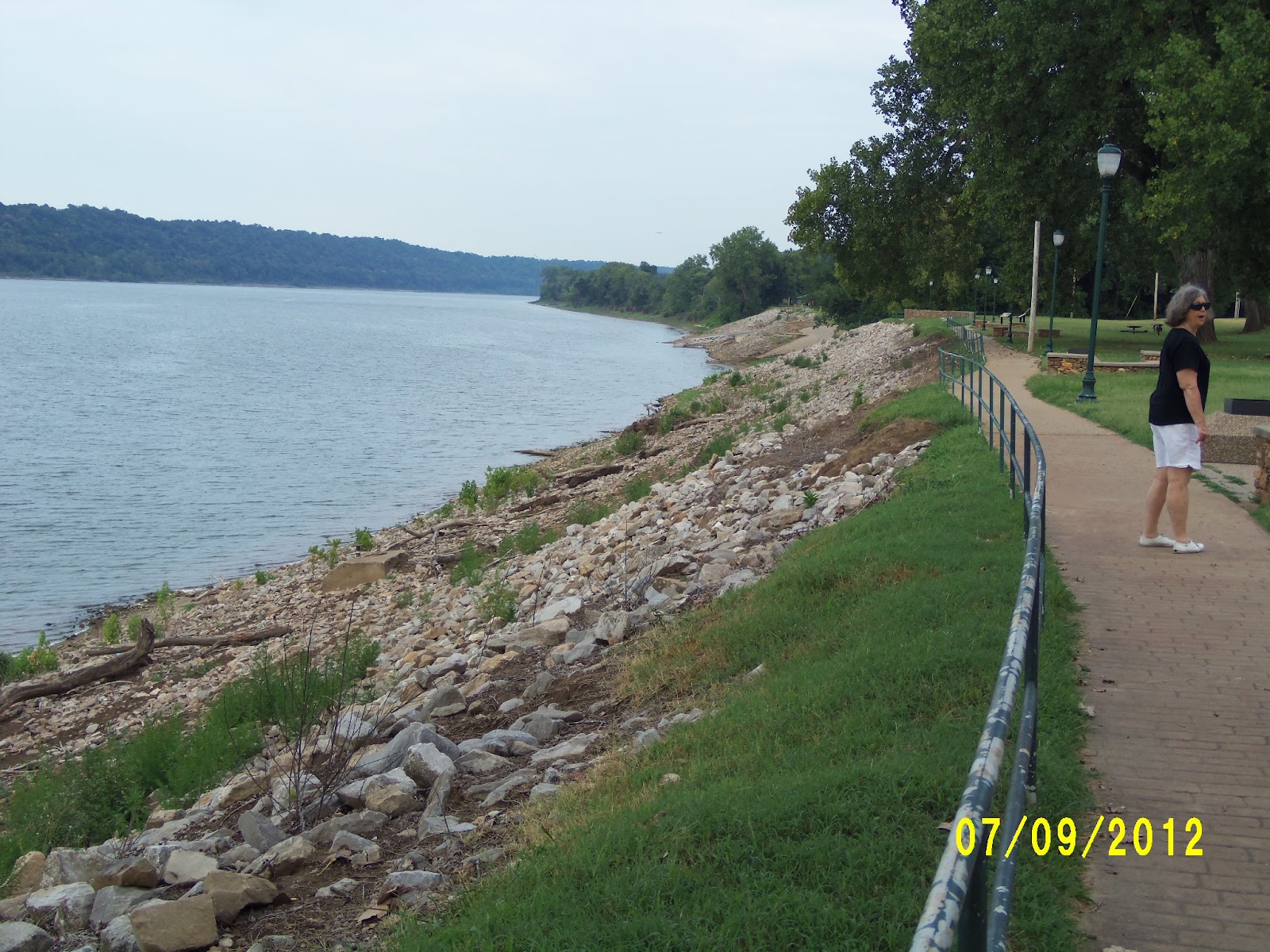
After supper at a local cafe, we walked along the Ohio River looking across to Indiana on the site of a Civil War battle.  We have now called it a day.  The sun will set eventually!